New Classical Macroeconomics: A Different Research Programme
The “new classical macroeconomics” term applies only to the works of Lucas and his associates. The paradigm that they had inaugurated soon underwent an inner evolution that led to the emergence of real business cycle modelling under Kydland and Prescott’s stewardship.
A further transformation, leading to the emergence of (second generation new Keynesian models) dynamic stochastic general equilibrium (DSGE) modelling, followed. These three modelling strategies should be considered as phases within the same research programme, the DSGE macroeconomics programme, the main features of which were present from the first instalment onwards. Drawing a contrast between two paradigms is a matter of selecting criteria against which they can be compared and assessing how they measure up to them. Table 8 summarises the results of such an exercise.The first point to be stressed is the change in the research agenda that occurred. The central object of study of Keynesian macroeconomics was unemployment - in a wider sense, the search for the malfunctioning of markets. In the span of a few years, the unemployment theme ceased to be an important preoccupation of macroeconomists; the business cycle took its place at the top of the agenda. Of course, variations in economic activity are a central item in the study of economic fluctuations, but in the new paradigm
Table 8 Contrasting Keynesian and new classical macroeconomics
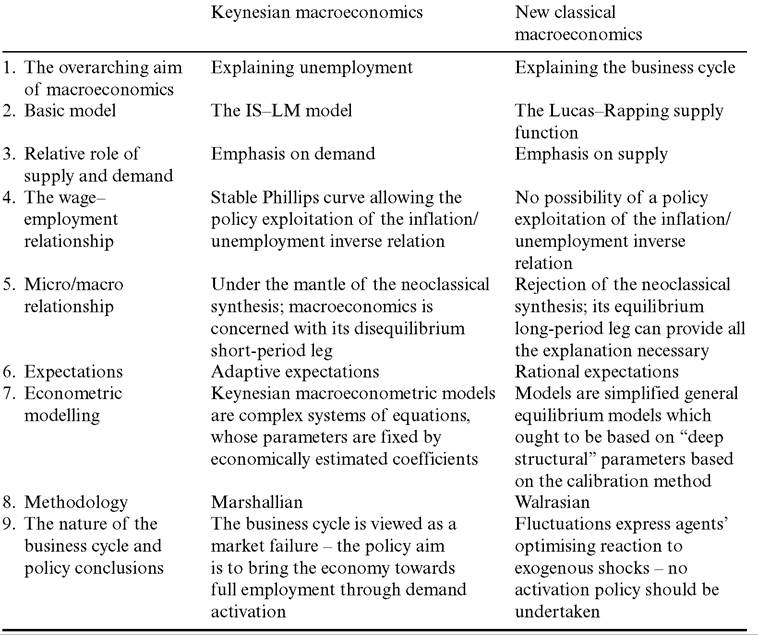
they are accounted for in terms of hours worked without consideration of the split between the employed and the unemployed.
Another stark difference concerns the way in which the business cycle issue is addressed. The challenge Lucas set himself was to construct an equilibrium theory of the business cycle, where the fluctuations of economic variables can be traced back to optimising decisions made by economic agents.
Instead of entering into a detailed description of how he progressed in this enterprise, we shall just say the following. According to the Keynesian approach, variations in employment result from changes in aggregate demand. The underlying picture is that labour suppliers are passive, employment decisions being made unilaterally by firms. Moreover, this approach tended to consider the supply of labour and the labour force as the same thing, taking for granted that any difference between the total labour force and the level of employment is involuntary unemployment. Lucas’s hunch (and Rapping’s because the so-called Lucas supply function emerged in Lucas and Rapping’s joint work (Lucas and Rapping 1969 [1981])) was that changes in the supply of labour, viewed as a result of optimising decision-making, play a central role in explaining fluctuations. His view, borrowed from neoclassical capital theory, is that the decision to participate in the labour market or to produce on a selfemployed basis are a matter of allocating leisure (and hence labour) both within a given period of time and over time. Economic agents ought to be depicted as comparing the wage rate at one point in time with the wage rate they expect to prevail later in time, say today and tomorrow. If the former is more advantageous than the latter, they will decide to work more today and less tomorrow.This intertemporal substitution phenomenon, Lucas contended, is decisive in explaining variations in the level of activity over time. On this insight, he constructed a model of the business cycle where variations in activity over time are due to two factors: exogenous monetary shocks, on the one hand, and agents’ imperfect information, on the other. In this model, agents receive one signal incorporating two distinct pieces of information. On their own, these two pieces of information would trigger opposite reactions, changing or not changing the total hours worked. Needing to engage in signal extracting, the optimal solution agents will adopt is to mix the two opposite reactions in some weighted way.
Hence the hours worked departs from what they would have been with perfect information. Here, Lucas claimed, rests the explanation of the variations in hours worked over the business cycle. Monetary shocks have real effects but, as argued by Friedman, the government cannot exploit them since they occur only when the changes in money supply are unanticipated.A totally different picture of the business cycle emerged. Earlier, the business cycle was viewed as the disequilibrium phenomenon par excellence, the manifestation of a market failure. The mere assertion of its existence was seen as an invitation to the state to take steps to make it disappear. In the new approach, the business cycle expresses the optimising reactions of agents to outside shocks affecting the economy. That is, business fluctuations are no longer viewed as market failures, and governments should refrain from trying to prevent their occurrence. Nor is there any rationale for acting upon them.