Neoclassical Trade Theory: Barone, Haberler, Heckscher and Ohlin
In a long footnote inconspicuously embedded in a textbook of economic principles, the Italian economist Enrico Barone (1908: 88-90) created a diagram shown in Figure 7 consisting of a nonlinear production possibility frontier (PPF) and a map of community indifference curves to depict in general equilibrium terms the gains accruing to an economy as it passes from autarky to free trade.
He thus anticipated similar diagrams presented some 25 years later by Jacob Viner, Abba Lerner, Wassily Leontief and Gottfried Haberler. In The Theory of International Trade with its Application to Commercial Policy (1936), the Austrian-born Haberler generalized Ricardian comparative advantage to an economy where price is defined by the opportunity cost of a commodity in terms of another, rather than the “real cost” of production utilized by Ricardo and the economists of the classical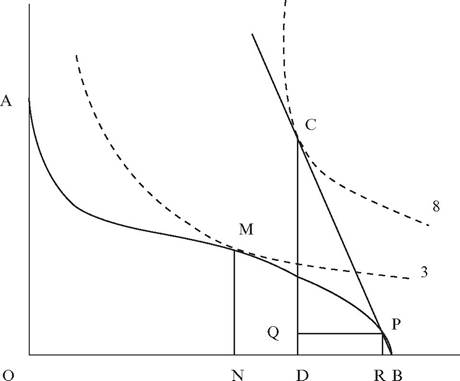
Figure 7 Barone’s 1908 representation of the gains from trade
school. Whereas the PPF is linear in the textbook Ricardian case since real costs of production are assumed constant for any level of output, the neoclassical PPF depicting the menu of outputs that can be produced with the economy’s factors of production given the available technology is concave to the origin. Its slope measures the opportunity cost of one commodity in terms of the other, and increases with the level of output because of increasing unit costs. In autarky the slopes of the two trading partners’ PPFs are different and signal their comparative advantage in a particular commodity. Unlike in the textbook Ricardian case, this slope is no longer independent of demand considerations and the mix of factors used changes along the PPF together with its slope. Haberler thus generalized the comparative cost model while accepting most of the welfare conclusions reached by the Ricardian school.
In an article published in Swedish in 1919 and translated into English in 1949 as “The effect of foreign trade on the distribution of income”, Eli Heckscher investigated the hitherto missing rationale in the Ricardian trade model for why comparative advantage differs across countries and how trade affects income distribution. The clue lies in the difference in the relative abundance of factors of production in various countries combined with differences in the intensities with which commodities use these factors. These features yield differences in commodity prices across countries that in turn lead to trade among them. With the additional assumption that techniques of production are identical across countries, Heckscher argued that trade causes the factor prices of trading partners to converge. They may even become equal if neither country becomes fully specialized, a result that was later proved rigorously by Paul Samuelson (1948, 1949) and became known as “factor price equalization”. As in the case of Haberler’s PPF, the difference between comparative costs in autarky is responsible for trade in the first place, but is subsequently erased by the very trade it engenders. After trade is established, and unlike the alleged Ricardian constant-cost case, the difference in comparative costs disappears since it is no longer needed to ensure continued trade.
In 1933 Heckscher’s student Bertil Ohlin published a book-length critique of the Ricardian model and elaborated an alternative trade model based on neoclassical assumptions (Ohlin 1967). Together with Heckscher’s 1919 article, it laid the foundations for what became the mainstream theory of international trade after World War II, the Heckscher-Ohlin or Heckscher-Ohlin-Samuelson theory. Ohlin accepted Heckscher’s theory that trade derives from differences in relative factor endowments across countries. However, he believed that the Ricardian model was based on false assumptions that must be overthrown in order to reconstruct the theory of trade on the new foundations sketched by Heckscher and the neoclassical school represented by Gustav Cassel. He therefore rejected Heckscher’s view that the Ricardian model could be reformed or generalized. The association of the term “comparative advantage” with the theory of comparative costs that Ohlin wished to discredit explains why this term does not even appear in the revised 1967 edition of his book.