Externalities as Resource Problems
Environmental problems such as air pollution, soil pollution, water pollution and so on are often described as externality problems, being analysed in terms of external diseconomies.
This tradition goes back to A.C. Pigou. His analysis was very timely after the Industrial Revolution: the railway network in Britain was extended rapidly, and steam locomotives emitted smoke and soot without any restriction, damaging woods along the tracks. Seeing that the costs of the damages were never reflected in tariffs, Pigou (1932) formulated this problem as a gap between social and private benefits. The gap is nothing but the external diseconomy.Those problems can be treated as resource problems as well without changing the essence of Pigou’s argument. In the above example of steam locomotives, the problem may be formulated as whether to allocate the right of use of the atmosphere along the railways to railway companies or owners of woods, and how to do so. This is nothing but a resource allocation problem, although atmosphere, one of the environmental resources defined here, is not marketable, so that its scarcity is not realized in a price.
Consider a representative consumer, who has a utility function U = U(y, E), where y and E denote a consumption good and clean atmosphere surrounding this person
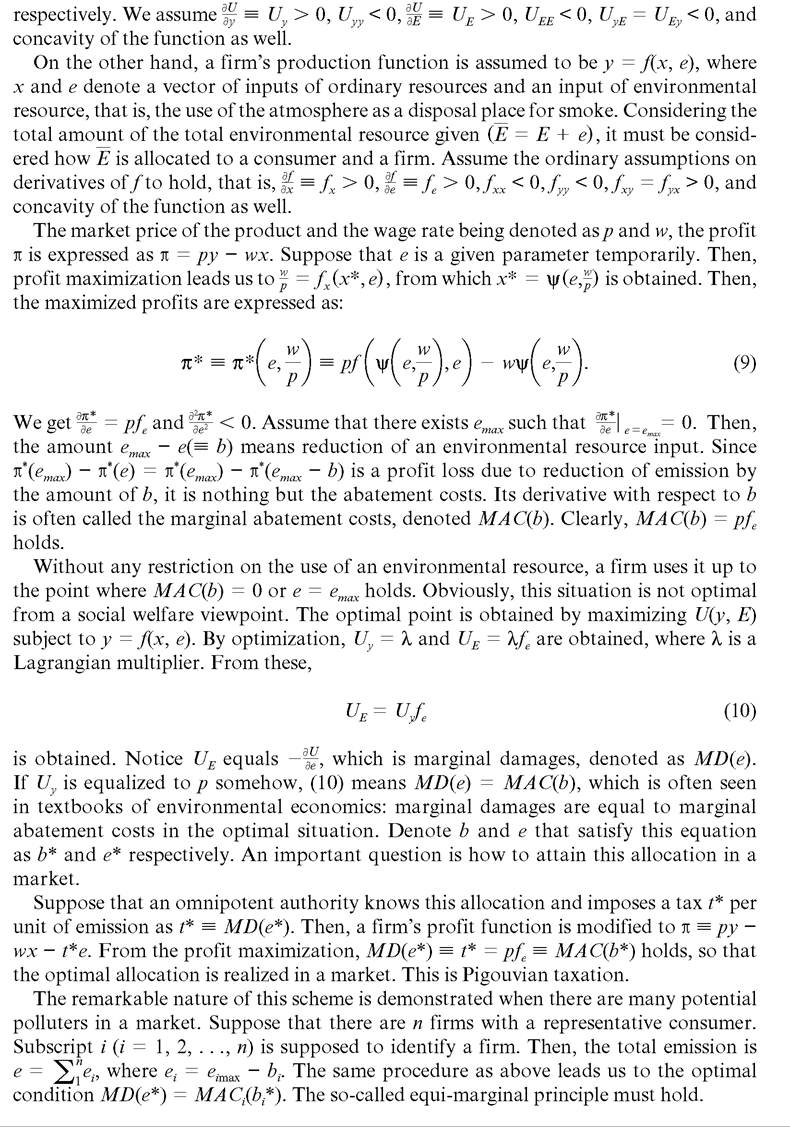
Again, setting MD(e*) = t* as a tax per unit of emission, the authority can achieve the goal where MD(e*) = t* = MACi(b *) holds in a market. The equi-marginal principle prevails not by command-and-control, but by individual incentives.
Four remarks are apposite. First, the applicability of a Pigouvian tax, at least at an abstract level, is based upon the condition that the authority knows the optimal allocation of resources. Otherwise she cannot set the optimal tax rate correctly.
Yet this does not seem probable in reality. At best, she can guess aggregate functions of marginal damages and abatement costs. If the authority, obtaining as much information as possible, can deduce the data on the emission level which is sufficiently close to the optimal one, Pigouvian tax may work well even if it does not exactly hit the target.Secondly, there may be situations in which the authority cannot obtain any information on aggregate functions of marginal damages and abatement costs. An emission tax, though it is not exactly a Pigouvian tax, can achieve the least cost for reduction of emissions even in such a case. This is because the equi-marginal principle holds when a tax rate is given. Although the total amount of emission reduction at the tax rate is not the optimal level, except by a fluke, the reduction is made with the least cost, being cost effective.
Third, on the condition that there is no new entry, it can be shown that a subsidy fulfils the optimality conditions. Suppose the omnipotent authority subsidizes polluters by 5* per unit of reduction of emission from a business-as-usual level, where 5* ? MD(e*). Again, 5* ? MD(e*) = MACi(bi*) is achieved. This is called Pigouvian subsidy. If there is a new entry of potential polluters, however, the optimal conditions collapse, since the subsidy is originally planned on the supposition that there are fixed numbers of polluters, so that the optimal conditions are different before and after the entry.
Finally, it can be shown that the above analytical framework can be generalized within a general equilibrium framework (Baumol and Oates 1988: ch. 4). It is not easy to implement a Pigouvian tax or subsidy in a rigorous sense, since, as already shown, the authority cannot generally be expected to obtain sufficient information to do so. This does not, however, imply that the underlying ideas to real policies based upon individual incentives cannot somehow be applied. So-called environmental tax or carbon tax may be regarded as a variation of a Pigouvian tax. Furthermore, its basic idea can be interpreted as the basis of the polluter pays principle (PPP), which says that dischargers of pollutants should pay for prevention costs of pollution. PPP has now been introduced into quite a few countries as an anti-pollution policy.