During the 1780s and 1790s, after the decline of the physiocratic school and before the publication of J.B. Say’s Traite d’economie politique, few French authors made lasting contributions to economic theory.
A clear exception is Achilles-Nicolas Isnard, even though recognition of his work had to wait until the late nineteenth century. Even in 1954 Schumpeter observed that Isnard had “as yet to conquer the position in the history of economic theory that is due to him as a precursor of Leon Walras” (1954 [1994]: 217).
Since then the engineer’s early contributions to value theory have been recognized more widely as well as the relevance of his conceptions for input-output theory. Still, Isnard’s contributions to mathematical economics have often been appraised in isolation and their relation to his wider social and economic thinking has rarely been studied.Achilles-Nicolas Isnard was born in Paris, most probably in 1748. Though the names of his parents are unknown, it appears that the Isnards were a relatively well-to-do bourgeois family. At the age of 19 Isnard entered the Ecole royale des Ponts et Chaussees, at that time the foremost institution of technical education in France. In his seven years at the school he received a solid training in subjects such as map design and architecture, and various branches of mathematics in which he obtained such proficiency that for a time he ended up teaching the classes in algebra and calculus. In the same period he also established friendly contacts with at least one prominent physiocrat, P.S. du Pont, and studied their works.
In early 1775 he was given his first posting as assistant engineer at Arbois. From the beginning Isnard’s career progression was hampered by a perceived lack of deference to his superiors and for two decades he did not gain any promotion. In 1781, for example, he was not only reported for not dealing firmly with farmers who refused the corvee, which he considered an oppressive institution, but he was also reprimanded for having his Traite des richesses published in Lausanne, across the Swiss border, without the required permission of his superiors.
From 1785 Isnard was stationed at Evreux where he busied himself with writing on engineering subjects and experiments with electricity. During the early years of the Revolution he became a prolific, though unsuccessful, pam- phletist. His initial enthusiasm for the Revolution cooled fast when it became clear that it would not deliver his ideal of a reformist and liberal monarchy guided by natural laws. In 1795, after the death of his wife Catherine, Isnard resigned from the engineering corps and for some years lived in straitened circumstances with his three surviving children in Paris. However, at the beginning of 1800 he was elected to the Tribunat, where he spoke frequently on fiscal matters and public works. He knew his fellow tribun, J.-B. Say, and soon became part of the “liberal opposition” against Bonaparte. Dismissed as a result, he took up the post of engineer, this time at Lyon. There he died of tuberculosis on 25 February 1803.Isnard published 12 works over a tumultuous 20-year period, a body of work that adds up to over 3000 (octavo) pages, but his modern reputation is based solely on a few mathematical passages in his first book the Traite des richesses of 1781. Although those passages have often been read in isolation, they are in fact elements of a more or less coherent formal analysis of value, reproduction and distribution that forms the central part of a more comprehensive economic theory. This economic theory is in turn part of a much wider social science to which Isnard aspired and which he referred to as the “science of man”.
As in Quesnay’s work, the notion of reproduction is fundamental in Isnard’s economic theory. Indeed, the engineer develops his conception as part of a critique of Quesnay’s depiction of circular flow and reproduction in the Tableaux economiques (van den Berg 2002). Isnard’s alternative construction is remarkable for its abstraction and clarity. The simplest of these systemes de richesses, which is the earliest two-sector model, reads: 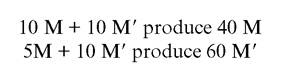 where M and M' are physical units of different commodities.
This Isnard provides at the very beginning of his Traite by deriving relative values using simultaneous algebraic equations. Starting with the case of the exchange of given quantities of two commodities, he observes that “the value of each unit will... be in inverse ratio to the number of units that is offered for exchange” (Isnard 1781, I: 18). Extending his analysis to the many-commodity case he observes that in order to find relative values between units of all commodities “one would have to formulate as many equations as there are commodities” (ibid.: 19). While noting that “[s]uch calculations would be very complicated in a system with a great number of commodities” (ibid.: 26-7), the engineer provides an illustration (or proof) of his seminal idea by calculating the relative values for the case of given quantities of three types of commodities (ibid.: 20). The historical importance of this piece of analysis is highlighted by Ingrao and Israel (1990: 64) who note that “Isnard was...
the first to suggest the condition of equality between the number of equations and the number of unknowns that, until the early twentieth century, was to remain the theory’s only answer to the problems of the existence and uniqueness of the vector of equilibrium prices”.Isnard sees the valuation of products in exchange and their reproduction as two distinct moments in an ongoing economic process. Equilibrium values obtained in the market decide the distribution of the system’s disposable wealth and inform the subsequent decisions of producers about what and how much to produce. But Isnard does not offer views about the “normal” distribution of the surplus. Despite very clear statements of the tendency towards a uniform rate of profit in different applications of capital, there is no attempt in the Traite to determine prices and the rate of profit simultaneously.
Besides the fundamental issues of value, reproduction and distribution, the work contains interesting discussions of consumption, the theory of money, the valuation of capital goods, foreign trade and taxation. Isnard’s Cathechisme social (1784) supplements his economics with a theory of human action and society. It is based on an original combination of sensationist psychology and natural law sociability, which underpins the radical liberal economic notions of the Traite.
Until the 1870s the influence of Isnard’s ideas was negligible, even within the so called French “econo-engineering tradition” (Ekelund and Hebert 1999). The classical political economists do not seem to have known the Traite des richesses, with the notable exception of J.R. McCulloch (1845), who called it a “learned and valuable work”. In 1878 Leon Walras was the first to recognize Isnard’s contributions to mathematical economics. Jaffe (1969) presents detailed evidence to argue that Walras did in fact borrow, without explicit acknowledgment, a significant number of ideas from the engineer in the construction of his theory of general equilibrium. More recently, similarities of Isnard’s reproductive schemes to those of Leontieff have been discussed (Steenge and van den Berg 2001). Kurz and Salvadori (2000) have noted especially the “striking similarity” of the two sector model of the Traite with the one Leontieff discusses in his early article “Die Wirtschaft als Kreislauf” (1928). Isnard’s work is a principal example of how in economics fundamental ideas can be overlooked for a long time.
Richard van den Berg
See also:
Formalization and mathematical modelling (III); French Enlightenment (II); General equilibrium theory (III); Input-output analysis (III); Wassily W. Leontief (I); Francois Quesnay and Physiocracy (I); Marie-Esprit- Leon Walras (I).