Duopoly
Two firms, which produce the same good, have an interest in agreeing with each other to fix a monopoly price, but each of them can increase its profit through an increase in its production.
The cooperative equilibrium, Cournot stresses, is unstable: “it could not persist unless a formal link is established; because one cannot... suppose... men making no errors or not being careless” (1838 [1980]: 62). Each producer tries to increase his revenue and must take into account the reaction of his competitor. He supposes that his competitor’s output is given: this is what is called Cournot’s conjecture. Taking an example in which each firm could alone meet demand at no cost, Cournot supposes that each firm fixes its production in order to maximize its revenue, given the output of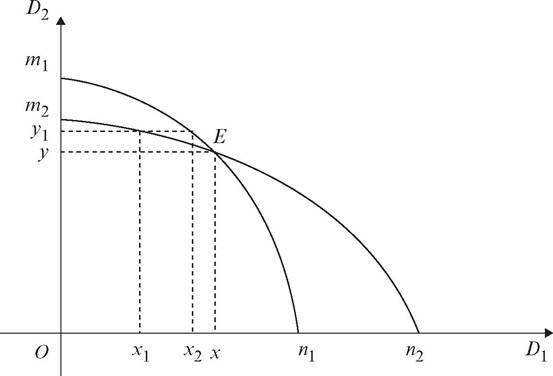
Source: Cournot (1838 [1980]: 60).
Figure 5 Cournot’s duopoly
its competitor. He thus expresses reaction functions using the inverse demand function

In Figure 5, the mini curve represents the reaction function of firm i, i = 1, 2. An equilibrium is reached at point E where each firm fixes its production at the level anticipated by its competitor.
Cournot could have supposed that the decision variable is the price instead of the quantity. Each firm would thus have fixed its price in such a way that p = [f (p) - D] is a maximum, Dj being the production level of its competitor. The result would have been the same. Each firm behaves as a monopolist, the demand for its product being the residual demand.
To study stability, Cournot describes a dynamical process where each firm fixes its production in turn, supposing that its rival will maintain its output at the level of the previous period.
If the output of firm 1 is Ox1, firm 2 will produce Oy 1, that is, a quantity such as to maximize its profits for a given Ox1. However, for the same reason firm 1 will produce Ox2. Cournot maintains that this process leads firms 1 and 2 to produce in the end respectively Ox and Oy. The equilibrium is stable. “If either of the two producers... momentarily departs [from equilibrium], he will be brought back to it by a series of reactions, the magnitude of which will be constantly diminishing” (Cournot 1838 [1980]: 61).Cournot’s duopoly theory and stability analysis were criticized almost 50 years after the publication of Recherches. Joseph Bertrand (1883: 503) maintained that the situation
described by Cournot was not an equilibrium: “Whatever could be the common price adopted, if one competitor diminishes its price, he would attract... the whole sales and double his revenues if his competitor does not react.” He discards the hypothesis of a uniform price and replaces the Cournot conjecture with the supposition that each firm takes the price of its rival as given. Edgeworth (1897: 117-18) picked up the idea and introduced a simple form of decreasing returns in the model: the production capacity of each firm is limited. He concluded that the outcome is indeterminate: the price will continuously fluctuate between a minimum required by the firm’s capacity, and a maximum, that is, the monopoly price. Irving Fisher (1898: 126) criticized all his predecessors and maintained that no firm supposes that its competitors will not react when it changes the level of production or the price. It is in the situation of a chess player: its problem is to know how its rivals will react to its decisions. Later, the work of John Nash led to an understanding of Cournot, which discards dynamics: Cournot’s solution is interpreted as an application of the theory of non-cooperative equilibria to duopoly analysis.