Dmitriev and Bortkiewicz
The moment scholars with greater mathematical competence than Marx, and accustomed by Walras to a complete disaggregation of production conditions and to simultaneous equations, are able to grasp the terms of the difficulty encountered by the surplus theorists in the determination of the rate of profits, a correct solution is quickly found.
The breakthrough is first performed in 1898, in Russian, in the form of a discussion of Ricardo. Dmitriev sees clearly the problem of apparent circularity that Ricardo confronted: “Thus, we are apparently trapped in a logical circle: profit must be known in order to determine value, but profit itself is dependent on value” (1974: 58). Dmitriev shows that one can surmount the problem through a “reduction” of the production cost of the given real wage basket to dated quantities of itself with the appropriate amount of profit on them (a “reduction” similar to the one to “dated quantities of labour” performed by Sraffa 1960: 35, except that Dmitriev takes the “reduction” to end in a finite number of steps), obtaining an equation where the sole unknown is r; the equation confirms Ricardo on the relevance of the “wage industries” only, and shows the irrelevance of labour values.
The importance of Dmitriev’s contribution is realized by Bortkiewicz. In the first (1906-07) of two articles on Marx, he takes up Dmitriev’s procedure as a way to surmount the erroneousness of Marx’s equation (2), thus recognizing that Marx’s problem is the same as Ricardo’s. In the second much shorter article (1907) Bortkiewicz criticizes Marx’s thesis of invariance of the aggregates in passing from labour values to prices of production; he uses a three-sector stationary economy whose sectors produce respectively the constant capital (assumed circulating), the variable capital, and the goods appropriated as profits; assuming that all goods produced in a sector have the same organic composition and can be treated as a single good, he applies the “transformation” as indicated by Marx but he also performs the correction indicated and not attempted by Marx, that is, he applies prices of production also to the constant and variable capital, obtaining the system:
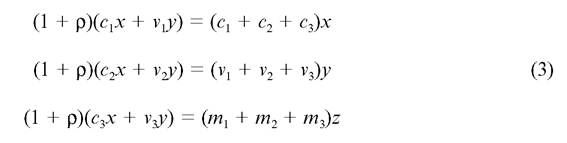
where ci, vi and mi are the constant capital, variable capital and surplus value (in labour values) of sector i (all labour-value magnitudes are data); p is the rate of profits; x, y and z are the ratios of price to labour value, that is, the prices of production of the quantity of output of each sector that embodies one unit of labour.
The equations determine rate of profits and relative prices simultaneously, and show the erroneousness of equation (2) (the first two equations suffice to determine r, independently therefore of the third sector; and the equality of labour value and price of production cannot be obtained simultaneously for more than one aggregate); but other implications are not made clear in the article (a fact that will negatively condition the debate on this article that starts 35 years later). In it Bortkiewicz does not stress that the stationariness assumption is superfluous, nor that - as is clear from the first article - labour values are not necessary for the determination of r, what is necessary is the complete disaggregation of production conditions. And it is only in the first article, not in the second, that Bortkiewicz insists that Marx’s mistakes do not mean inconsistency of the idea, common to Marx and to Ricardo, and in fact clearer in Marx, of the rate of profits as resulting from the “deduction” of part of labour’s product - “deduction” being the term Bortkiewicz prefers, but clearly expressing the same idea as Marx’s “exploitation”. But Bortkiewicz’s first article remains unnoticed by Marxists even longer than the second one.So by 1907 it has been proved twice (although the proof is essentially limited to circulating capital and no technical choice) that the classical analytical difficulty with determining the rate of profits is surmounted by a fully disaggregated description of capital, that is, of production conditions; so Jevons and Walras were mistaken when accusing Ricardo of trying to determine two variables - price and rate of profits - with one equation (the equation determining product price as equal to cost of production inclusive of the rate of profits). However, for many decades this achievement remains unrecognized, undiscussed by Marxists, and without any impact on the general development of economic theory.
In 1942 Bortkiewicz’s second article is rediscovered by Sweezy, who presents equations (3) as confirmation that Marx was right: rate of profits and prices of production are determined, Sweezy argues, by labour values.
A debate, slowed down by the limitsof the article, takes many years to rediscover, with Seton (1957), that the full disaggregation needed in order correctly to determine prices of production and rate of profits shows that the only role of labour values is that of being one possible choice of units for the commodities (which refutes Sweezy). Because of lack of clarity on the structure of the classical approach, the importance of the demonstrated determinability of the rate of profits is not grasped; on the contrary, owing to the prevalent interpretation of the labour theory of value as essential to Marx’s view of the origin of profits in the exploitation of labour, the erroneousness of Marx’s equation (2) and superfluousness of labour values are perceived by many as undermining Marx.
More on the topic Dmitriev and Bortkiewicz:
- Prices and profits
- Bortkiewicz on Ricardo and Marx
- References and further reading
- Marginal Utility Theory
- Theory of capitalist development
- Contents (alphabetical)
- References and further reading
- The theory of value and prices
- Marxian Political Economy in 2016: “What is Left?”
- Wassily W. Leontief was born on 5 August 1905 in Munich, where his father, also named Wassily W. Leontief, at the time was completing a doctorate in political economy.