David Ricardo and Comparative Advantage
Two years before Ricardo published his Principles of Political Economy and Taxation in 1817, Torrens hinted in literary terms at the concept of comparative advantage. In his Essay on the External Corn Trade (1815: 264-5), Torrens wrote that England would gain by exchanging its cloth for Polish corn even though English land “should be superior to the lands of Poland” and could be cultivated profitably.
His reason was that “the capital which should be employed in manufacturing, would obtain a still greater excess of profit; and this greater excess of profit would determine the direction of our industry”. Ricardo’s formulation is generally regarded as superior to Torrens’s since he expressed this concept in numerical terms, derived its policy implications and even quantified the gains from trade.Chapter 7 of Ricardo’s Principles contains the following paragraphs that relate to the exchange of cloth and wine by England and Portugal:
The quantity of wine which she [Portugal] shall give in exchange for the cloth of England, is not determined by the respective quantities of labour devoted to the production of each, as it would be, if both commodities were manufactured in England, or both in Portugal.
England may be so circumstanced, that to produce the cloth may require the labour of 100 men for one year; and if she attempted to make the wine, it might require the labour of 120 men for the same time. England would therefore find it her interest to import wine, and purchase it by the exportation of cloth.
To produce the wine in Portugal, might require only the labour of 80 men for one year, and to produce the cloth in the same country, might require the labour of 90 men for the same time. It would therefore be advantageous for her to export wine in exchange for cloth. This exchange might even take place, notwithstanding that the commodity imported by Portugal could be produced there with less labour than in England.
Though she could make the cloth with the labour of 90 men, she would import it from a country where it required the labour of 100 men to produce it, because it would be advantageous to her rather to employ her capital in the production of wine, for which she would obtain more cloth from England, than she could produce by diverting a portion of her capital from the cultivation of vines to the manufacture of cloth.Thus England would give the produce of the labour of 100 men, for the produce of the labour of 80. (Ricardo 1817 [1951b]: 135)
These paragraphs contain Ricardo’s famous numerical example of international trade according to comparative advantage, outlining both the reasons for trade and the gains that accrue to each trading country As Sraffa (1930) and Ruffin (2002) point out, Ricardo presents the number of workers that each country requires to produce the amounts of cloth or wine that it exports to the other and the number of workers it would require to produce the bundle of the commodity it imports in exchange. Thus England uses 100 men to produce the cloth it exchanges for an amount of wine that would require the labour of 120 Englishmen, so that its gains from trade are 20 men who can be employed in other pursuits. He makes a similar calculation for Portugal, finding that whereas 80 men can produce its wine exports, 90 would be required to produce the cloth it imports from England so that Portugal’s gains from trade are 10 men. Each country’s trade satisfies Viner’s eighteenth-century rule for gains since its exports require a lower workforce than would be needed to produce its imports.
In Ricardo’s example, comparative advantage is represented by the fact that in autarky (or the absence of trade) the relative price of each country’s export commodity is lower than in the other country. To express this in algebraic terms, let aji be the amount of labour needed to produce one unit of commodity j in country i, wi labour’s wage in country i, ri the profit rate paid on circulating capital in the form of advanced wages, and pji the price of commodity j in country i in autarky.
The cost of producing commodity j in country i is the sum ajiwi(1 + ri) of the cost of labour ajiwi and the profits rajiwi earned on circulating capital ajiwi. Since competition equates price and unit cost in each country, we obtain for any two commodities j and k:
or

where yi = wi(1 + ri) is income per worker in country i. Dividing the first expression in (1) or (2) by the second we obtain country i’s autarky price ratio of good j in terms of good k:
Table 7 Workers needed annually to produce one unit of cloth and wine in England and Portugal
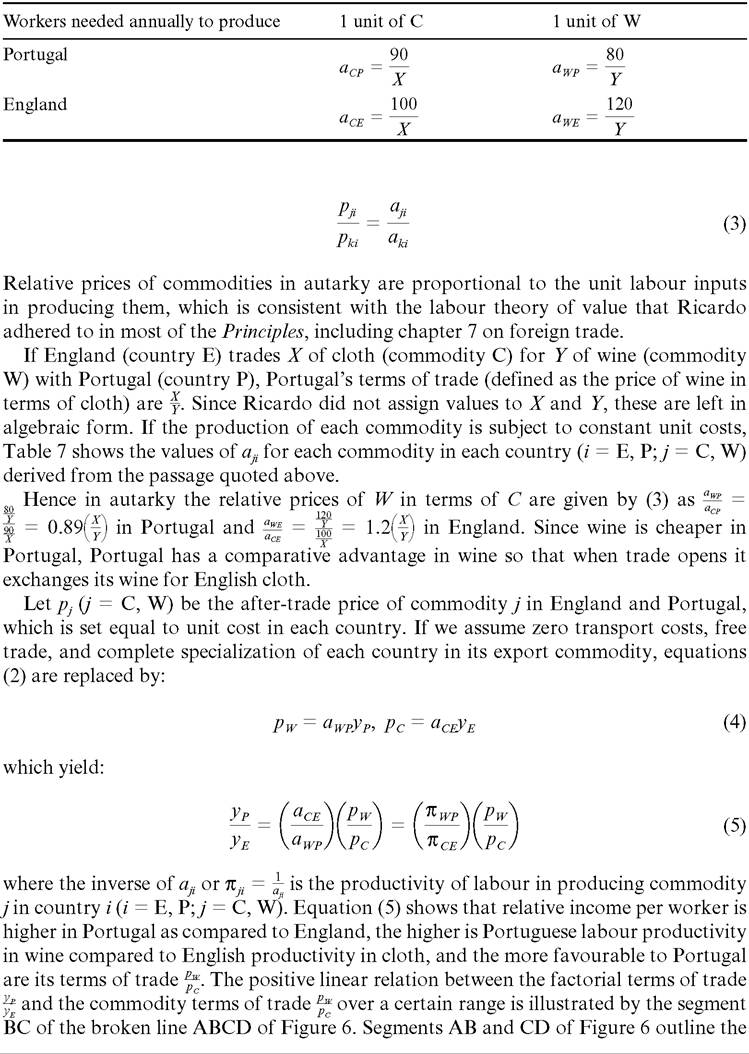
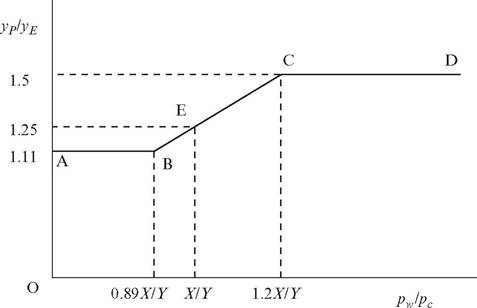
Figure 6 Relative per worker incomes in the Ricardian model
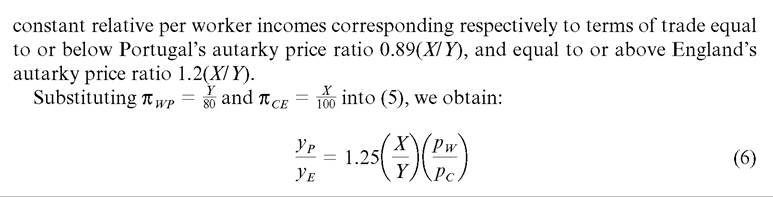
When % is equal to the terms of trade X/Y, (6) yields = 1.25 as shown by point E in Figure 6. We conclude that Portugal’s absolute advantage in both wine and cloth causes its income per capita to be 25 per cent higher than England’s.
Although comparative advantage is Ricardo’s signal contribution to the theory of international trade, absolute advantage retains a fundamental importance in his trade model since it determines the relative standards of living in the two countries. Ricardo himself was fully aware of the power of absolute advantage in setting Portugal’s standard of living relative to England’s. In the last sentence of the passage from chapter 7 of the Principles quoted above, he stated “Thus England would give the produce of the labour of 100 men, for the produce of the labour of 80” (Ricardo 1817 [1951b]: 135).
Since the produce of 100 Englishmen is exchanged for the produce of 80 Portuguese workers, the ratio of their per worker incomes is indeed 100/80 = 1.25 as shown by point E in Figure 6.So far, unit labour costs have been assumed to be constant in each country. However, Ricardo’s analysis of the determinants of rent and profits was an important foundation for the principal policy implication that flowed from both the Essay on Profits (Ricardo 1815 [1951a]) and the Principles: the repeal of Britain’s Corn Laws leading to free trade in grain. The numerical examples that he used to illustrate his analysis of rent and profits are based on diminishing returns to labour when more labour is added to a fixed stock of land. These diminishing returns in the face of a constant real wage of labour cause the money wage to rise and the profit rate to fall.
Most of the examples of foreign trade found in the Principles concern trade in corn (Maneschi 1992). In chapter 7, Ricardo asserts that the two principal gains from trade for a country such as Britain are the efficiency gains arising from a reallocation of resources in line with comparative advantage, and a rise in the rate of profit:
It is quite as important to the happiness of mankind, that our enjoyments should be increased by the better distribution of labour, by each country producing those commodities for which by its situation, its climate, and its other natural or artificial advantages, it is adapted, and by their exchanging them for the commodities of other countries, as that they should be augmented by a rise in the rate of profits. (Ricardo 1817 [1951b]: 132)
Ricardo went on to point out that one way for Britain to achieve the latter gain was to promote free trade in wage goods such as corn:
It has been my endeavour to shew throughout this work, that the rate of profits can never be increased but by a fall in wages, and that there can be no permanent fall of wages but in consequence of a fall of the necessaries on which wages are expended.
If, therefore, by the extension of foreign trade, or by improvements in machinery, the food and necessaries of the labourer can be brought to market at a reduced price, profits will rise. (Ibid.)While Ricardo regarded technical change (“improvements in machinery”) as adventitious and not amenable to public policy, he tied cheaper wage goods directly to the abolition of the trade policy responsible for the high price of corn: the Corn Laws.
Instead of an economy composed of two constant-cost sectors of the type analysed above, consider a Ricardian two-sector economy consisting of an agricultural sector subject to diminishing returns to labour and a manufacturing sector subject to constant returns. Each worker is paid a fixed subsistence wage s consisting of corn that is advanced at the beginning of the production period. Let Lj be the labour force in sector j, where j can denote a for agriculture or m for manufacturing, and L = La + Lm be the total labour force. In line with Ricardo’s reasoning in chapter 6 (“On profits”) of the Principles, assume that agricultural (or “corn”) production is given by a function f(La) whose slope f(La) declines with the value of La but always exceeds s. The profit rate r is given by the excess over s of the marginal corn product of labour divided by s, or:

Although the profit rate is set in the corn sector, competition equalizes its value in both sectors. Assume that, when trade opens, the terms of trade p*, defined as the relative price of corn in terms of cloth, are lower than the domestic relative price of corn which has risen over time because of diminishing marginal returns to labour in the corn sector. The consequence of trade for the sectoral allocation of the labour force is to increase manufacturing output at the expense of corn output, so that La falls and Lm rises if L is constant. As (7) shows, this raises both the marginal corn product of labour and the profit rate, and accomplishes the secondary benefit of trade that Ricardo mentioned above besides the primary benefit of a more efficient allocation of resources according to comparative advantage. A higher profit rate is expected to lead to greater investment and a higher growth rate, thus slowing down the economy’s approach toward the stationary state. It provides a dynamic benefit from trade supplementary to the dynamic trade benefits to which, as was noted above, Adam Smith called attention in the Wealth of Nations.