Black, single-peakedness and majority rule
In 1948, that is, even slightly before Arrow, Duncan Black (1908-1991), a British economist, introduced the notion of single-peaked preference (Black 1948). He studied the effects of this assumption on the outcomes generated by majority rule.
He proved among other results what is now called the “median voter” theorem. He used a kind of geometrical setting. Assume that the set of options (candidates, social states or whatever) is a closed interval [a, b]. Furthermore, assume that individuals have ordinal continuous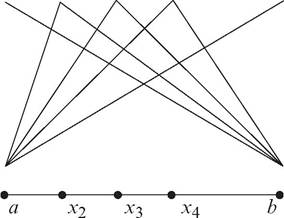
Figure 9 Black’s single-peakedness utility functions ui that are increasing until they reach a maximum, and then decreasing until they reaches b. In Figure 9, we have the curves of five functions representing preferences.
In Figure 9, u1 reaches its maximum for option a, u2 for option x2 and so on. Individual 3 is the median individual and the option selected by the majority rule is x3. In the figure, the functions are strictly concave, but the definition allows strict quasi-concavity. When the space of options is no longer one-dimensional, difficulties arise (see Austen-Smith and Banks 1999; Schofield 2008).
Black’s analysis will now be presented in a discrete setting. The discrete version of single-peakedness is due to Arrow (1951). First let us define majority rule. Assume that individual preferences are given by complete preorders. Majority rule is an aggregation function such that for all (distinct) options x and y, x >s y if and only if the number of individuals i for whom x >i y is > than the number of individuals for whom y >i x, and y > s x otherwise. The following definition of single-peakedness is adapted from Sen (1966).
A set of complete preorders over X satisfies the condition of single-peakedness over {a,b,c} # Xif either a ~ b and b ~ c, or there is an option among the three options, say, b, such that b > a or b > c.
We will say that a set of complete preorders satisfies the condition of single-peakedness if it satisfies the condition of single-peakedness over all {x,y,z} # X. Figure 10 is a geometrical representation of this condition over {a,b,c}.Black’s theorem Let us assume that there are at least two individuals and three options, and that all individual preferences belong to a set of complete preorders satisfying the condition of single-peakedness. Let us assume further that the number of individuals who are not indifferent between x, y, z is odd for any {x,y,z} # X. Then the majority rule is a social welfare function satisfying conditions I, P and D.

Figure 10 Black’s single-peakedness over {a, b, c}
Since the majority rule obviously satisfies condition I, P and D, this simply means that ' s is transitive. The specific condition on the number of non-indifferent individuals can appear as problematic, but it is not so problematic since if we drop it we still get a QT-social decision function (>s is then transitive). The literature of this sort, where individual preferences are restricted by some kind of super-rationality, is abundant and has been excellently surveyed in Gaertner (2001). A special kind of restriction refers to the so-called economic domains and is, of course, related to Black’s analysis since in the standard microeconomic framework, individual preferences are continuous, convex or strictly convex, and so on (see Le Breton and Weymark 2010).