Aristotle: Production and Acquisition, Justice in Distribution and Exchange
The Aristotelian conception of man as a political animal is connected with his economic idea of the household as the fundamental unit of the city, following the venerable tradition of Hesiod (Works and Days 342-413).
Economics, the art of house-holding, comprehends everything which holds house, estate, and family together. It is first concerned with the life of the family, including the slaves, whom Aristotle regards as indispensable (Politics 1253b8). Only if we had automatic weaving and music making, could we do without slaves. Aristotle as a rational thinker clearly feels that he is on uncertain ground with his defence of slavery. Perhaps some are, by their nature, born to be slaves? However, he admits that many are slaves, although they are neither of inferior talent nor barbarians (ibid. 1254a-1255b). It is observed in the pseudo-Aristotelian writing Oeconomica that slaves obtain a wage, in the form of nourishment. It is emphasised that slaves can reach high ranks in positions which require trust (for example, as supervisors). Aristotle recommends to treat them well and to free them after a predetermined time, and he ordered some of his slaves to be freed in his testament. However, uneasiness remained.The problem, which is here dealt with by Aristotle in philosophical terms, had been treated poetically by Homer, where slavery is described as a tragic fate by the very heroes who will enslave others by conquest, if they can. Also, the god Hephaistos in Homer has made automata, maids made of bronze, who serve him like slaves; the god does not need to enslave living beings (Schefold 1997: 99-145). However, slavery is a tragic fate for humans, and this is reflected by the honest Aristotle in his avowed inability to provide a satisfactory philosophical justification.
The aim of house-holding is to provide the material basis of the good life of the Greek citizen and the family.
This requires a level of material well-being which is neither so high that it distracts from the main aim nor so low that there is no room for philosophical reflection and political activity. Private property and material incentives are accepted, with a criticism of Plato as if the latter had ever made communism a general principle (Politics 1261a6). Aristotle differentiates between the art of house-holding and the art of acquisition (ibid. 1256a12). House-holding uses the means of the household, acquisition provides them. Acquisition is natural, if there is an analogy with the acquisition in nature, by animals. Hunting, fishing, farming, shepherding and robbing are thought to be natural in this sense - the last suggestion is a little shocking, but, as analogues of the lions, remember the conquerors of Homeric times. It also corresponds to nature, if surplus products of the house are exchanged for others which cannot be made yourself. It is an exchange of values in use, for which the need is limited; Aristotle explicitly rejects the saying by Solon, according to which it is a deplorable fate of man not to know the limits of riches (ibid. 1256b34). To have a measure, to correspond to a middle between extremes is the nature of the good. To increase the household indefinitely is an error which Aristotle ascribes to a kind of vitalism, to the desire to live instead of living well (∈υ ζηv). The means of the good life must be defined and limited like the good life itself.The other form of acquisition, the unnatural one, is an art to enrich oneself; we here call it by one of the expressions used by Aristotle, chrematistics. It is an acquisition which disregards the boundaries and has no limits (Politics 1256b40-1257a1, 1258a7).
The borderline between the two kinds of acquisition is drawn as follows: a shoe is really used if it is worn, but it can also be used as mean of exchange (Politics 1257a10). It is natural, and not a matter of chrematistics, if households complement each other, one providing shoes and the other providing corn.
However, the shoe has not come into being for the sake of exchange (^ γαp α^αγ⅛ ∈v∈κ∈v γ∈γov∈v, ibid. 1257a13). Hence there is an abuse if it is produced for exchange. We have to conclude that the cobbler must have the use of the shoe in mind, when he makes it, and not the selling price. The cobbler therefore is like the Platonic good shepherd, who is concerned with the welfare of his sheep and not with eating or selling them. It is not easy for us to think in this way, except if we have an artist or a scholar in mind who are completely dedicated to their tasks, without thinking of future success or an addition to the salary. The scholar offers his insights to the public and he gets some support, but he does not bargain. The opposite position would be a worker who works for piece wages. As we shall see, Aristotle ranks wage labour among the chrematistic pursuits.Aristotle develops chrematistics historically. The exchange of values in use between households generated trade, a trade which transcended the limits of the city. Since many goods were difficult to transport, people consented to use and take in exchange things which were useful in themselves and easy to handle, such as iron and silver (Politics 1257a35). This is how money arose. It was a mean to facilitate exchange, but it became an end in itself for many people. They interpreted wealth as a mass of money and tried to obtain as much of it as possible, hence the definition “all men engaged in wealth-getting try to increase their money to an unlimited amount” (ibid. 1257b34).
So when currency had now been invented as an outcome of the necessary interchange of goods, there came into existence the other form of wealth-getting (chrematistics), trade, which at first no doubt went on in a simple form, but later became more highly organised as experience discovered the sources and methods of exchange that would cause most profit. (Ibid.
1257b1-5)Aristotle rejects this form of acquisition. Bravery shall not make money, but engender courage, and also the art of strategy and medicine shall not do that, but procure victory and health (ibid. 1258a11).
Exchange as such does not necessarily become chrematistic, as long as it takes place within the confines of house-holding, for which there are limits, and, to this extent, the art of exchange is natural (Politics 1257a29), but otherwise blameworthy (ibid. 1258b1). The art of acquisition of the household is necessary but not so chrematistics (ibid. 1258a15). King Midas had wished that everything that he touched would turn into gold. He died of hunger, when his wish was fulfilled. This example shows how meaningless it is to regard a mass of money as wealth. Natural wealth and chrematistics are different. Chrematistics is associated in the beginning with petty trade. Later it becomes a matter for powerful merchants and seafaring in long distance trade. Chrematistics will then begin to assimilate even other arts, for example, if medicine is used not to heal but to make money.
The difference between natural acquisition and chrematistics, therefore, is not only that the former has limits, while the latter is limitless, but in the attitude to production; it is not only a matter of ethics, but also of aesthetics. Aristotle sees profit only as arising from trade, not in production. Interest can therefore not be derived from production. Hence the famous denunciation: usury is an unnatural form of acquisition which is justifiably hated, since money begets money (Politics 1258b3). The argument would later be developed by the scholastic authors who, like Aristotle, defined money as a means of circulation (ibid. 1257a3) so that its use as an instrument of credit seemed illicit. Aristotle’s reference to nature (physis) represented an important innovation. Without invoking divine law, order is created by the visible necessities of natural life; there are natural laws.
Aristotle proceeds from theoretical to practical considerations and enumerates the different forms of acquisition in the house; there then follow the chrematistic techniques of trade, money lending and wage labour, with transitional forms. It does not occur to him that they should be prohibited. He realises that they can be useful for the state. There is the pseudo-Aristotelian book (the second book of Oeconomica) which deals with the techniques of increasing the revenues of the state; it illustrates that the Aristotelian school analysed the monetary techniques at least empirically. We must conclude that Aristotle’s teaching in the end amounts to advice for his students - young citizens - not to take up the chrematistic pursuits because they might miss the good life. His problem is not the alienation of work. It remains an ideal for the philosopher and free citizen not to have to worry about material sustenance. Chrematistic acquisition means to forget about the true aims and to make wealth-getting an end in itself instead of treating it as a mean for higher ends.
Aristotle’s theory of just exchange is not directly linked with his theory of natural acquisition, in that it is part of his ethical theory (book V of Nicomachean Ethics), but we shall discover organic links between both approaches to what the moderns regard as an economic problem.
Aristotle develops his consideration of exchange in the context of a discussion of justice which is the most perfect virtue (Eth. Nic. 1129b26); virtuous life leads to human happiness which culminates in the vision of truth. We are here concerned only with justice which determines a share. It is divided into distributive and commutative justice. The former concerns the distribution of honour, money and other objects, which can be shared among the members of the community (ibid. 1130b32). Distributive justice takes proportionality into account, hence the situation in society of the person who shall receive. The principle of proportionality is general, but it must be based on a certain conception of dignity and merit, and these conceptions are different according to the form of governance.
Democrats value freedom, oligarchs wealth, aristocrats virtue (ibid. 1131a25). If persons A and B stand in relation A : B, so must the objects a, b, which they are to receive, so that we have A : B = a : b. It is a symbolic proof that proportionality is preserved if the persons are augmented by what they receive (ibid. 1131b4); in fact we have, by the law of proportions:A : B = a : b = (A + a) : (B + b).
“Mathematicians” call this proportionality “geometric”, says Aristotle (Eth. Nic. 1131b13). Each receives according to desert, respecting the inequality of the members of the community. However, it may be difficult to decide in what desert consists. We only have to remember the Homeric poems in order to realise that this problem is central to Greek culture from the beginning; the Iliad turns around the question of who shall keep the main booty, the maiden Briseis: Agamemnon as the leader of the army or Achilles as the most eminent hero (Ilias I 182-351).
Another form of justice determining shares is commutative justice, which is needed in many matters of daily life such as commerce, credit, but also theft or other objects of litigation. Status plays no role here. If A has received a (which is too much) and B has received b (which is too little), hence, if a > b, both shall receive according to arithmetical proportionality. By this Aristotle (Eth. Nic. 1132a2) means what we call arithmetical mean; he intends a redistribution according to:

Justice in exchange is based on reciprocity (Eth. Nic. 1132b20). This does not coincide with either justice in distribution or commutative justice, for reciprocity can be unjust. If an officer hits a soldier as punishment, reciprocity would mean to strike back, but this would not be just, for it would be against the law (ibid. 1132b30). Acting in appropriate reciprocity and donating keep the city together, otherwise it would be a city of slaves. Anthropologists ponder why one feels the obligation to reciprocate, but Aristotle emphasises that it does not suffice always to wait for gifts in order to respond with counter-gifts, but that one should precede the others in donating (ibid. 1133a6). The true wonder of the functioning of the community consists in the spontaneity of giving, and the dry philosopher recalls the beautiful custom to erect public altars for the Charites, the goddesses of grace and thankfulness. The central role of the liturgies in Athenian life was here alluded to in a philosophical doctrine in the evening glow of the independent city state, as also in his Politics (1261a31): τo αvτL7T∈'∏'ov⅛∂ς σωζ∈L τας 7r6λ∈Lς (reciprocity saves the cities) (1261a31).
The discussion of reciprocity now moves from spontaneous donation (μ∈ταδoσuς, Eth. Nic. 1133a2) to immediate exchange against a counter-gift (dvτuδoσuς, ibid. 1133a6). It is not necessary to recall the Charites anymore, since gift and counter-gift follow each other immediately. The spheres of culture and politics and the economic sphere are not separated but touch each other. What is a proportionate counter-gift? Aristotle begins with objects and persons standing in a relation of proportionality as in distributive justice. In our notation A : B = a : b as above (Aristotle's notation is a little different and refers also to geometrical illustrations). Exchange implies a “diagonal conjunction” (an Aristotelian technical term also to be found in Eud. Eth. 1242b12 and elsewhere): prior to exchange, A is equipped with a and B is equipped with b. A and B are on the top angles, a and b on the bottom angles of a quadrangle, hence after the exchange “along the diagonals”, A has b and B has a. The diagram symbolises the exchange of property (Polanyi 1968: 107, is mistaken in his belief that the price is given by the point at which the two diagonals cross). Each person has given to the other some of his “work”, an architect, and a cobbler exchange a house and shoes in Aristotle's example. Now the persons are unequal (Eth. Nic. 1133a18), as the text emphasises, but the objects are made equal (ibid. 1133a14). How can this be, as they are qualitatively different? It has been proposed - but the textual evidence for this is meagre - that this form of just exchange should be symbolised by a proportion of proportions, in which each person remains in relation to the object in the same proportion after the exchange as this person had held before:

This proportion of proportions (Soudek 1952, following Euclid) holds, as one verifies easily, if and only if a = b; the objects are equalised, while the persons are not. Aristotle continues, however, saying that, through exchange, the persons as well are “to be made equal” (Lσασ⅛ηvocu - Eth. Nic. 1133a19); the geometric proportion is used and total identity results: the initial A : B = a : b becomes after the exchange A : B = b : a, hence a = b and A = B (ibid. 1133a34); the persons are equal as traders. Finally, the arithmetical mean is resorted to according to commutative justice to restore equality, if the exchange happened to be unequal, and the “too much” of the one has to be divided and to be given to the other (Eth. Nic. 1133b3).
Aristotle now has moved from gift exchange to commodity exchange without saying so. Gift exchange does not necessarily imply an exchange of equivalents, as Aristotle makes clear elsewhere when he discusses friendship, for the gift of the higher-ranking person may be of higher value than the counter-gift of the lower-ranking person if the former is friendly with the latter, but the converse may also happen, if the lower-ranking person wishes to obtain a favour from the higher-ranking person (Eud. Eth. 1242b17). Here, however, Aristotle is concerned with commodity exchange, for he asks why gifts and counter-gifts can be set as equal, although they are qualitatively different. He answers that it is need (chreia, Eth. Nic. 1133a28) which holds the exchange together. He also says that the relationship is not natural; money has been invented to measure things according to nomos which means law (ibid. 1133a31), but nomos is here meant as convention: people adopt money (and fix prices) by convention. Prices can also be prescribed; the estimation can be that of an overseer of a market - at any rate, everything has to be “estimated” (ibid. 1133b15). Money is a warranty for the future (ibid. 1133b13) and acts as an intermediate, being a “measure” to “set equal” (ibid. 1133b18). Aristotle uses an example (a house or a bed) in order to show that having an exchange ratio between different commodities is essentially the same thing as having one between commodities and money (ibid. 1133b24).
Many interpreters have tried to discover a theory of prices in Aristotle. The two great strands of price theory, labour theory or cost theory of value and the subjective theory of value both seem to originate here. Aristotle says that each of the exchanging persons gives of his work (ergon). In this view, both sides exchange equal increases of value, owing to equal effort, and “proportionality” would refer to equal arithmetical differences of value added (Eth. Nic. 1133a10-17). On the other hand, he says that it is need (chreia) which holds the exchange together. However, he also says that everything in the transaction has to be measured by some unit (∈vl τ∪v∪ παvτoc μ∈τp∈bσθocb, ibid. 1133a26), without saying to which specific quality the measure is to be applied. Aristotle may have had some intuition that prices were related to cost and demand, but the wording and the context do not yield much for the development of the corresponding theories. The term ergon refers to the object produced by work, not to labour time, and to measure labour time was not as much a concern for slave owners as it became when wages were to be paid in the early modern period. The term chreia emphasises objective need rather than desire.
How far removed this conception can be from subjectively determined demand becomes clear if we relate the Aristotelian exposition of the problem of just exchange to his theory of households. There, households were thought to exchange their surpluses in order to assemble the necessary means for the good life. This is reminiscent of Sraffa's idea of a production of commodities without a surplus (Sraffa 1960: 3). Let aij denote the amount of commodity j needed by household i and assume that each household has a surplus of only one commodity (the cobbler is dedicated to the production of shoes and he also owns a plot on which he produces vegetables, but he consumes the latter himself and brings only the shoes not needed by his family to the market). We assume that households of the same kind are aggregated. Together they form a city which is autarkic. If total output of each commodity j is normalised to 1, we must then have a1j +... + anj = 1, with n commodities being produced by the corresponding number of types of households; i = 1,..., n; and it follows, if the resulting non-negative matrix A is indecomposable, as is natural to assume in this context, that a positive vector of prices p exists, such that:
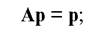
prices are determined by the needs (chreia) of the households to reproduce themselves and by the product (ergon) they can bring to the market.
We might therefore say that Aristotle’s philosophy of just exchange points not only towards subjectivism and the labour theory of value, but also towards the modernised classical theory of prices. The multiplicity of meanings is not evidence of inconsistency in Aristotle, but the result of his looking at exchange from different perspectives, using different mathematical analogues. His theorising is conceptual and not the construction of a formal model, but it has inspired model-building. If we add chrematistics, a pursuit of wealth beyond needs, the framework of static reproduction is broken and we can, looking back, again see two lines of thought develop towards the present. On the one hand is the idea of accumulation of capital without limits to growth and, on the other, that of equilibrium: profit-making firms must sell to households in order to obtain factors. In the latter case, households will provide labour only up to the point where the wage ceases to compensate for the disutility of work and they will provide capital only as long as the sacrifice for future consumption is compensated by the satisfaction from present consumption. We know that both Marx and Bohm-Bawerk felt indebted to Aristotle, both directly and via the medieval and early modern interpretations and developments of Aristotelian economics.