Applied empirical economics - Pareto’s law
In the area of applied economics, Pareto is most well known for his attempts to establish general empirical uniformities, especially his research on income distribution. In the “La Courbe de la repartition de la richesse” (1896) and the Cours Pareto undertook empirical study of income based on taxation records from England, Prussia, Peru and towns in Italy, to consider the form of distribution of income.
For the levels of income above some arbitrarily determined minimum cut-off point, he found that the distribution of income in many societies over longer periods of time was largely captured by a general equation, which, in reduced form, is represented by equation 1 below; and by the corresponding double log version of that equation, which is given by equation (1*):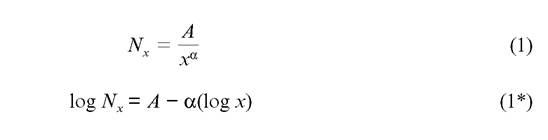
where

Three basic scientific uniformities emerged from this research. First, the distribution of income is not given by chance but still follows a general pattern (that is, an income distribution function exists and it is not normally distributed). Second, a characteristic of this general distribution is that income inequality is a uniform social phenomenon across different societies and across different periods of history. Third, empirical investigation of income data using the Pareto distribution shows that the value of a was generally close to 1.5, with empirical estimates ranging from 1.13 to 1.89. Francis Y. Edgeworth (1896, 1897) and Pareto (1897) debated this issue with vigour, focusing mainly on whether the form of the distribution function is best represented by Pareto’s equations or other distributions, most notably the Pearson distribution.
But perhaps most controversial was Pareto’s examination of the question of income inequality.
To that end, he suggested that a suitable index of inequality in income distribution (ux) is given by the quotient of the number of people accruing some arbitrary level of income, x, or more (Nx), and the number of people accruing a minimum income, h, or more (Nh). Given the form of the Pareto distribution, that index of inequality can be represented by equation (2).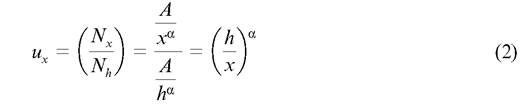
According to Pareto, inequality diminishes when the index number given by equation (2) increases. Consequently, inequality falls in the face of a rise in the minimum income h and/or a reduction in the parameter a, which indicates that the slope of the log form of Pareto’s income distribution curve becomes less steep and, as a result, increases the number of people with an income of at least x). As these events are also indicative of economic growth, Pareto put forward the proposition, now known as Pareto’s law, that real per capita growth is necessary “to increase the level of the minimum income or to reduce the inequality of income” (Pareto 1896-97 [1971]: 1097). Pigou (1912), however, refused to accept this proposition and was vigorous in his rejection of Pareto’s law, although his analysis was based on a flawed reading of Pareto’s Cours (McLure 2013).