1930-53
In the early 1930s, the dictatorship of the proletariat was proclaimed to be the basic economic law of socialism. Prices were deemed to be a political, rather than an economic matter.
Theories of the optimal sizes of industrial and agriculture enterprises were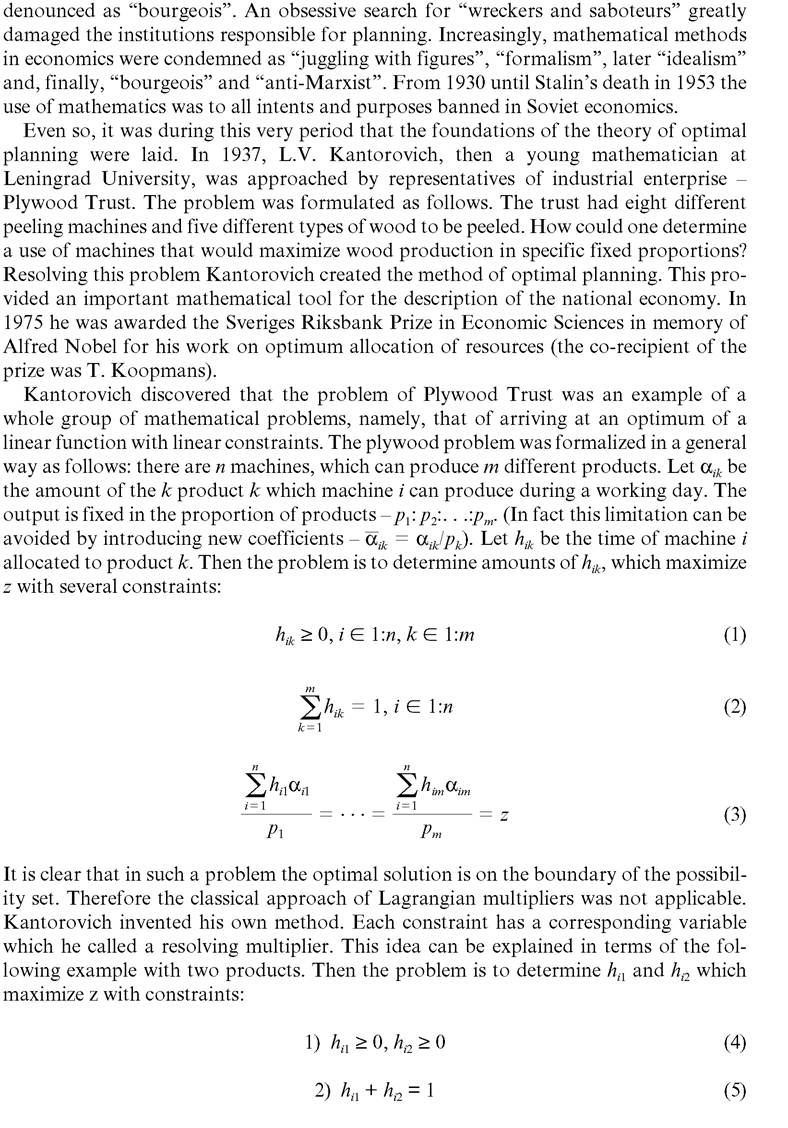
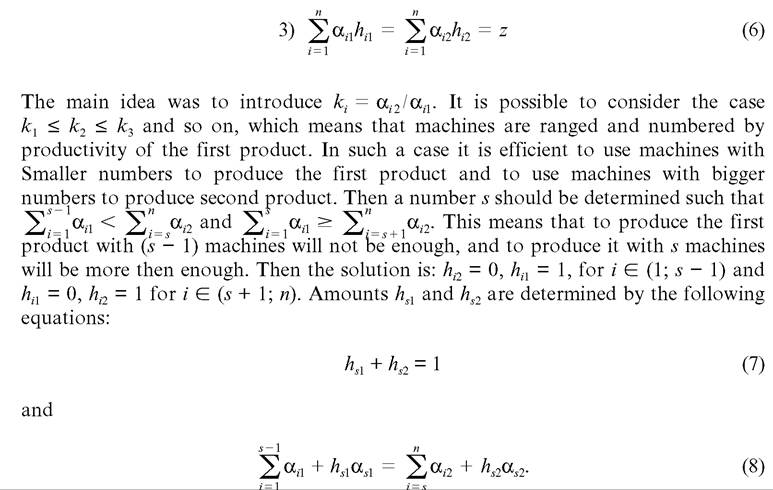
Kantorovich noted that the solution of the initial problem is equivalent to the determination of the following quantities: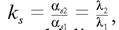 which determine the optimal plan. He
called quantities λ1 and λ2 resolving multipliers. Obviously such an approach was valid for any number of products.
Kantorovich published these results in 1939 in a brochure at Leningrad University (Kantorovich 1939 [1960], reprinted in Nemchinov 1959 [1964]). In addition to the Plywood Trust problem, he analysed numerous other economic problems. In a supplement, he provided analytical and geometrical proofs of the resolving multipliers method. In the geometrical proof it was shown that resolving multipliers characterize a hyperplane separating two convex sets determined by the conditions of the optimization problem. In fact, even at that time Kantorovich understood that an optimal plan is inseparable from prices. “It is somewhat ironic that at practically the same time that the great debate over the feasibility of socialism was taking place between Lange and Hayek in England, a Russian unknown to them had proved the mathematical existence of planned socialist prices” (Gardner 1990: 644).
At this time, however, Kantorovich was unable to apply his approach to national economic planning. Even the use of mathematics for the solution of local economic problems was politically dangerous since the mathematical school in economics was considered to be consorting with capitalism.
During one discussion a professor of statistics, B.S. Yastremskii, even accused Kantorovich of “speaking about the optimum, whilst the fascist Pareto also spoke of the optimum” (Kantorovich 1986: 60). In his memoirs, Kantorovich writes that in view of such attitudes he tried in his brochure (1939) to avoid using the term “economic” referring instead to the “organization of production”. Also, he could not openly discuss the implications of resolving multipliers (Kantorovich 1986: 55).What he could do, however, was to publish a mathematical version of his results. In his article of 1940 Kantorovich proved that for the problem of minimization of convex objective function with a compact feasibility set the criteria for the optimal solution is the existence of a linear function passing through the optimal solution and having the same value as the objective function. It is clear that in modern terms this linear function determines the optimal plan of the dual problem.
The general mathematical solution of the optimization problem made feasible the solution of a number of practical economic problems. The first was the transportation problem. In 1940 Kantorovich and M.K. Gavurin drafted an article on this problem, but owing to the negative attitude to mathematical economics that prevailed at the time, it was not published. The mathematical version was published later (Kantorovich 1942 [1958]).
After the beginning of the war with Germany in 1941, Kantorovich was involved in military research and served in the Naval Engineering College. In January 1942, the college was transferred to Yaroslavl, where Kantorovich had started and in November completed the first version of his book on the efficient use of economic resources. He delivered lectures on this work in a number of institutions, but economists by and large did not support him. This activity became dangerous for him and he abandoned economic research. After the war, however, he became involved in mathematical work related to the atomic programme.
For this work, in 1949, he was awarded the Stalin prize and this enabled him to return to economics.In 1949 it became possible to publish Kantorovich and Gavurin’s article on transport problems. In this particular case, resolving multipliers are named potentials, which were interpreted as regional prices of transported cargos. In the same year Kantorovich in collaboration with V.A. Zalgaller solved the problem of the optimal cutting of materials (Kantorovich 1949; Kantorovich and Zalgaller 1951). Their work proved that the application of optimal cutting methods produced economies of up to 5 per cent of materials. Zalgaller was the first in the world to apply optimal methods in practice - at the Leningrad Railway Carriage-Building Plant.
Kantorovich’s ideas influenced V.V. Novozhilov, who had begun his work on the efficiency of investments during the late 1930s. In 1943, Novozhilov wrote an important article (published in 1946) in which he outlined the procedure for planning (English translation Novozhilov 1956). The elaboration of the plan was considered to be the solution of an optimization problem in which the total sum of labour inputs was to be minimized, given constraints on the availability of capital goods, which were to be allocated to different investment projects. In his procedure, the so-called norms of “inversely related expenditures of labour” play a crucial role. Using what was, in fact, Kantorovich’s method of resolving multipliers, Novozhilov showed that the optimal solution of his problem is attained if, for each final product, that investment project is adopted which has the lowest sum of actual labour costs plus other input values at their norms of inversely related expenditures. As G. Grossman has pointed out, “these norms are, of course, actually the interest rate on capital and the scarcity rents of physical resources” and Novozhilov’s concept resembled the concept of opportunity costs (Grossman 1953: 330).
Although Novozhilov’s theory is well known, some points are worth mentioning.
First, Novozhilov’s problem of plan construction was actually a mixed-integer linear problem, but he did not present it in its fully explicit form. Thus, his recourse to a method of solution by linear programming and his use of shadow prices were not entirely justified. Secondly, and more importantly, his new approach to planning implied radical changes in the entire economic system. Opportunity costs ought to be included in prices, cost accounting ought to be introduced on this basis and the procedures for planning would have to be changed. Moreover, the theory of value would have to be further developed.Grossman thought that Novozhilov’s solution was close to the general equilibrium systems of Walras and Barone. However, this was officially denied by Novozhilov. Being a competent economist and a graduate of the Kiev University before the Revolution, Novozhilov should have been familiar with Walras’s theory. It seems, however, that his knowledge of Soviet planning, with its iterative calculation of the balances of physical products and of distribution of limited resources, had a much greater influence upon his thought.
Another important development during this period was V.S. Nemchinov’s appeal in 1946 for the creation of Soviet econometrics, which he interpreted as a theory of mathematical calculations in planning (Nemchinov 1967: 182). This proposal was rejected at that time as being “bourgeois”, econometrics being considered to be a Western invention.
The approaches of mathematical economists were totally unacceptable in Stalin’s time. Kantorovich enjoyed some protection, because he worked in the military sphere. Novozhilov, on the other hand, was severely criticized and eventually dismissed from the Leningrad Polytechnical Institute. Nemchinov, who was the President of the Academy of Agricultural Sciences, was dismissed from this position in 1948. He was accused of “idealism”, which was thought to be the application of the formalist bourgeois methodology of mathematics to the fields of biology and economics.